
Guide · Updated 2026-09-14 · USPS rates effective July 12, 2026
EDDM cost, sizes and requirements: the 2026 guide
Every Door Direct Mail costs $0.26 per piece in postage plus printing. This guide covers the 2026 EDDM Retail and BMEU rates, the size rules that make a piece eligible, the indicia, the 200-to-5,000 quantity limits, and how to pick carrier routes.
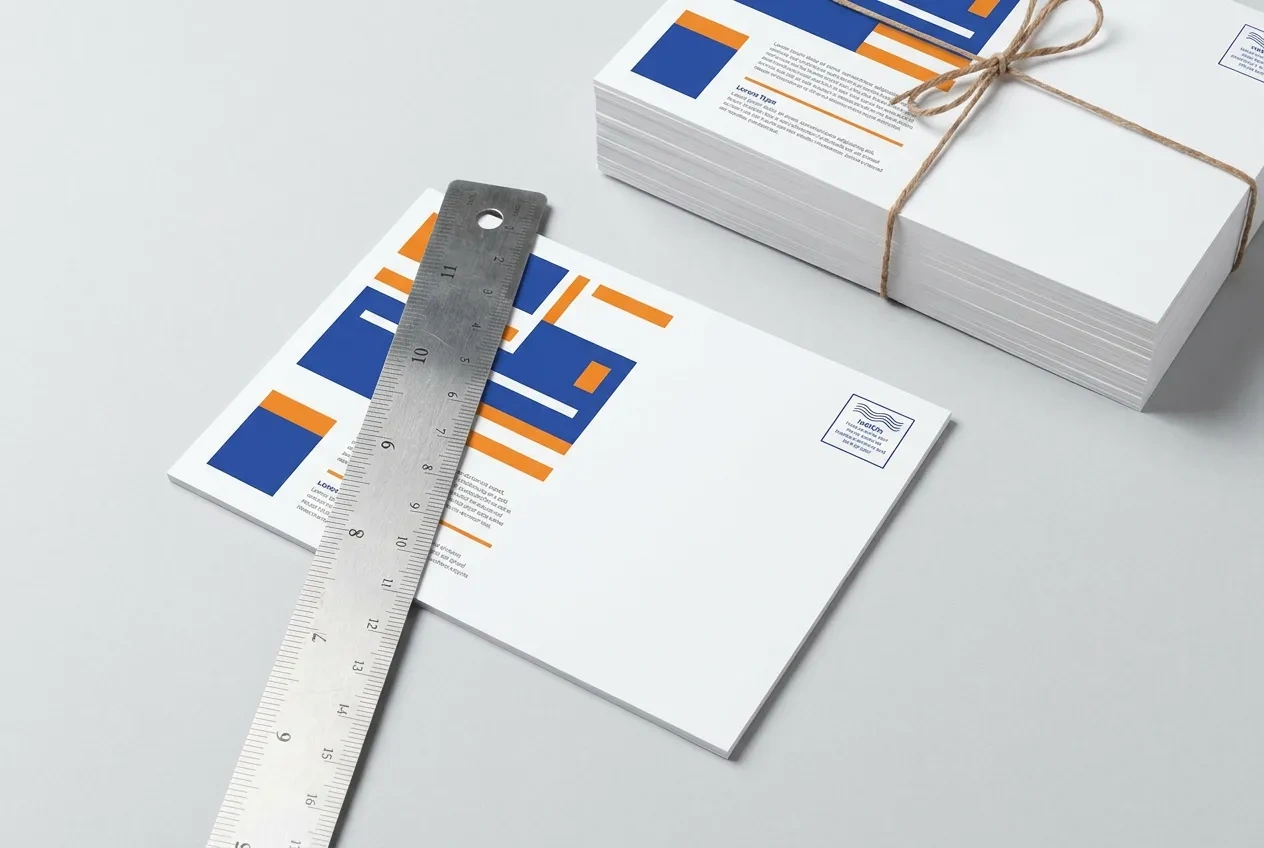
Every Door Direct Mail is the USPS program that lets a business mail every address on a carrier route without a mailing list, a permit or individual addresses. It is the least expensive way to saturate a neighborhood, and it has a short list of rules that trip up first-time mailers: the piece has to be a certain size, it has to carry a specific indicia and address block, it has to be bundled a certain way, and there are minimums and maximums per ZIP per day. This guide covers all of it at the rates and rules in effect for 2026.
How much does EDDM cost in 2026?
EDDM Retail postage is $0.26 per piece, effective July 12, 2026 (up from $0.247). EDDM through the Business Mail Entry Unit, which requires a Marketing Mail permit, is $0.259 per piece at the DDU entry rate. There are no other USPS fees for EDDM Retail. Printing and bundling are the rest of the cost: with us, a 6.25×11 postcard is $0.22 per piece at 1,000 pieces and $0.14 at 5,000, so a 5,000-piece EDDM campaign costs about $2,000 all-in, or $0.40 per home.
| Quantity | Print + bundle per piece (6.25×11) | Postage per piece | All-in per piece | Total |
|---|---|---|---|---|
| 500 | $0.32 | $0.26 | $0.58 | $290 |
| 1,000 | $0.22 | $0.26 | $0.48 | $480 |
| 2,500 | $0.17 | $0.26 | $0.43 | $1,075 |
| 5,000 | $0.14 | $0.26 | $0.40 | $2,000 |
| 10,000 | $0.12 | $0.26 | $0.38 | $3,800 |
| 25,000 | $0.10 | $0.26 | $0.36 | $9,000 |
EDDM size requirements
An EDDM piece must be a USPS "flat", which means it exceeds at least one of the letter-size limits: longer than 10.5 inches, or taller than 6.125 inches, or thicker than 0.25 inches. It may be no larger than 12 by 15 inches, no thicker than 0.75 inches, and no heavier than 3.3 ounces. That is why the most common EDDM postcard is 6.25×11: it is the smallest jumbo card that clears the 6.125-inch height rule. A standard 6×11 does not qualify.
- 6.25×9 — the smallest common EDDM postcard
- 6.25×11 — the most popular size, the same footprint as a jumbo postcard
- 6.5×12 — a little more room at little more cost
- 8.5×11 — a flyer or a folded 11×17 menu
- 9×12 — the largest common postcard size
- 11×17 folded to 8.5×11, or 12×15 maximum
The indicia and the address block
Every EDDM Retail piece carries a permit-free indicia in the upper right of the address side that reads, on four lines, PRSRT STD / ECRWSS / U.S. POSTAGE PAID / EDDM RETAIL. Below it, in place of an address, the piece must say "Local Postal Customer" (or "Postal Customer"). BMEU EDDM pieces use the mailer's permit indicia instead. Our templates place both correctly for every size, and every uploaded design is checked before it prints.
Quantity limits and bundling
EDDM Retail requires a minimum of 200 pieces per mailing and allows a maximum of 5,000 pieces per ZIP code per day; larger mailings are either spread over days or entered through the BMEU under a permit, which has no daily cap. Pieces are bundled in stacks of 50 to 100 with a facing slip (PS Form 3587) on each bundle showing the route, the count and the mailer, and the mailing is accompanied by a postage statement and a route listing. Bundles are dropped at the post office that serves each route, not at any post office. We do all of the bundling, paperwork and delivery.
Choosing carrier routes
The USPS EDDM Online Tool shows every carrier route in the country as a shape on a map, with the number of residential and business addresses and demographic summaries (median age, household size, income) for each. Select by ZIP code, by drawing a radius around an address, or one route at a time. Routes typically run 300 to 800 addresses. You can exclude businesses and PO Box sections. We will pull the map with you and confirm the count before anything prints.
EDDM Retail vs. EDDM BMEU vs. targeted mail
Use EDDM Retail for a neighborhood mailing up to a few thousand pieces per ZIP: no permit, flat rate, simplest paperwork. Use EDDM BMEU when the mailing is large or multi-city and needs to drop in one day, or when you want business-only routes. Use a targeted list, mailed as Marketing Mail, when your customer is a minority of households on any route; the postage is higher ($0.395 versus $0.26) but you stop paying to reach people who will never buy.
Answers
Questions this guide answers
What is the EDDM rate for 2026?
EDDM Retail is $0.26 per piece and EDDM BMEU at DDU entry is $0.259 per piece, both effective July 12, 2026. Printing and bundling are extra; a 6.25×11 EDDM postcard costs about $0.40 per piece all-in at 5,000 pieces with us.
Does a 6×11 postcard qualify for EDDM?
No. A 6×11 is letter-size and mails at letter rates with an address. EDDM requires a flat, at least 6.125 inches tall or 10.5 inches long, which is why the standard EDDM postcard is 6.25×11.
How many EDDM pieces can I mail per day?
Between 200 and 5,000 pieces per ZIP code per day at the Retail rate. Larger or multi-ZIP mailings are entered through the BMEU under a permit with no daily cap, which we handle under our permit.
Do EDDM mailers need a return address?
A return address is not required on EDDM Retail pieces, but the indicia and the "Local Postal Customer" block are. Most mailers include their business name and address anyway, because recipients look for it.